
 |
| ... I almost mistook the red coloured water for tomato soup |
Wednesday, April 11, 2012
why you shouldn't eat and paint at the same time

Tuesday, April 10, 2012
learning about reproduction photography
 |
 |
One of my important part-goals for spring 2012 has been to learn properly about reproduction photography. Lately my paintings have become more tricky to take good photos of (a lot of white, monochrome in strong colours - often red and pinkish in thin layers) and I have been swearing over how I can not make them justice in spite of all the time I spend colour correcting in the computer afterwards...
My strength as a photographer lies more in seeing possibilities and using ambience ... not being "correct".
So today I had hired a photographer to teach me how to take good reproduction photos of my paintings and how to use photoshop better for the afterwork. I had a vague idea of how most works, but learning from a professional sure makes a difference! It's a smart short cut. Now I am asking myself why I didn't do this earlier... Not that I can say I'm mastering it, but after a little bit more of practice ... ?
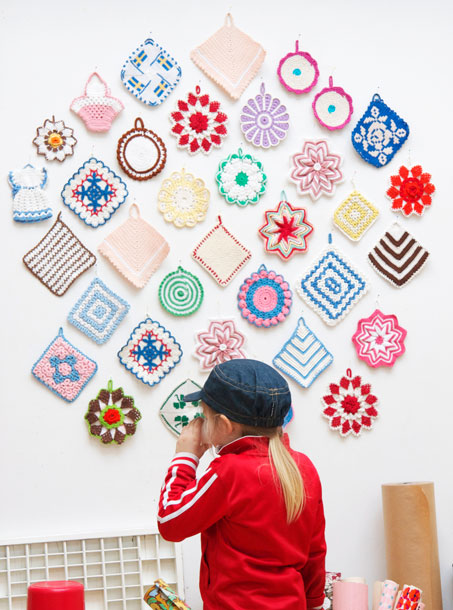
[for anyone worrying about my results - the photos above were taken with my iPhone documenting the photo session - and are not my great "reproduction photos"]
|
Sunday, April 08, 2012
studio visit: Tina Frausin
It’s a sunny spring day when I jump on my bike to visit Tina Frausin in Studio Agnes. Tina Frausin is just back from Småland where she has been preparing for giving a glass-casting course. Just before that she was in India for a month to explore the possibilities to get something cast in bronze there. Tina started out as a glass artist but nowadays her artistic focus lies on the possibilities and expressions of materials in a wider definition. Tina Frausin’s studio is situated in the basement of an apartment building on Hisingen in Gothenburg. Hisingen is industries and suburbs, but not the fancy sort of suburb. It has a history of insecurity, gangs and burning cars. Nowadays it has gotten calmer and they are constructing new apartment buildings here, but it is still not the part of town you show the tourists.
- How long have you been in this studio and how big is it?
- Since 2004, which makes it 8 years. Studio Agnes, as we call it, is 140 m2 and contains several rooms. I share this working space with two other artists Ida-Lovisa Rudolfsson and Jenny Skrufserud.
- And then you found this studio?
- Yes, I wanted something better and started to look for a studio together with Jenny who I knew from my glass education in Bornholm, Denmark. This studio is a basement and had once been housing a security company, but when we looked at it five folk high school students were renting the premises and had painted it in all the colours of the rainbow. Each room was in a strong colour representing the person situating it; yellow, purple, red …
Jenny and I thought that ...
maybe it wasn’t in the area we had thought would be the one for us and ...
maybe not the kind of premises we had imagined - but ...
it seemed ok and not that expensive…
and it worked out fine!
- What is the best with this studio?
- It doesn’t even take me 5 minutes to ride my bike here. Also for me, it is great, because I work with all these different kind of materials – in my former studio it was difficult to even get hold of a screw … that’s what so great with having a studio here – you can find a sand blasting firm, industrial coating, retails stores (like home improvement) and more on walking distance, or just a few minutes bike ride. There are all these small industries here in this area. But at the same time Studio Agnes is still in a residential area and it is just wonderful that on a nice day I can take out a table on the lawn, next to our door, and work outside. Not that I can leave things unattended … but I can work calmly.
- Do you wish something were different with your studio? Is there something not working?
- Haha … the low ceiling… I can stand on a small step and reach the ceiling! Also I’ve had this studio for so long now and it is like it has grown into what it can be, matured – and I wouldn’t say there is much that can be improved further - it is ready. I feel happy when I come here and it is cosy. But sometimes I feel it might be time to change studio – could it be that the grass is greener on the other side? … I’m especially dreaming of big windows and a high ceiling. I’m feeling that my art pieces are rapidly growing in size. I’m working with these weird kind of sculptures, many of them hanging from the ceiling.
- Maybe you need a barn?
- Yes, a modified barn with huge windows and hoist in the ceiling! Because there are certain limitations for me here in the studio. But it depends on how you work, of course; it’s perfect for sketching, making models and working on ideas.
- Do you also work on your administration and on your computer here?
- I used to, but I took the computer away as it became a big time thief. So much time is needed for paper work and computer and it is so easy that it takes too much time. When I had my computer here I couldn’t concentrate on being creative in the same way, not the studio creativity way. Nowadays I have a small portable computer here functioning only as a “radio” or for checking occasional e-mail. I have my office at home which has made it so much easier for me to divide my work. For example I try to decide – especially when there are several commissions to apply for - like now – this week I will work on administration for three days. I don’t come here to the studio at all then; instead I concentrate on that task. This way I become more effective as I can decide that the other two days I don’t even have to look at the computer – and instead concentrate on the practical - hands on - work in the studio. But it all depends on what deadlines I’m working towards, of course. If it is an exhibition I could very well just spend several weeks only here in my studio and nothing in front of the computer!
- If you could dream – how would you like to divide your time then? Intense concentrated creative studio time for some months – followed by concentrated administrative periods?
- That is an impossibility – administration also means applying for getting to make commissioned public art and applying for grants etc; uploading images, filling forms and writing ideas … if I would to ignore that for like three months I would loose the flow in my business … You can NOT choose that.
- Do you ever feel lonely here in your studio?
- Yes. Jenny is almost never here since the very beginning. Actually you could say we are only two people actively working here. Ida-Lovisa works here a lot, but unfortunately it’s like we have different schedules as she’s following the school hours, being a mother. Sometimes we are here at the same time, but not very often. I long for having colleagues just for taking a coffee break together. Because something can happen when exchanging some casual words with another artist, something that won’t happen when you are sitting there all alone. You could just throw out some ideas and share some thoughts that might lead somewhere – I feel I miss that exchange … or to just to be able to ask for an opinion and get some feedback when you need it…
One Saturday when I was visiting an opening at Konstepidemin I was thinking Oh here, here, I should have a studio here - to be in a context, where they help each other .. not in a basement on Hisingen where people think who are those weird people in the basement … [Konstepidemin, or Epidemic of Art, houses studio space for more than 100 artists. Located in the former epidemic hospital are also galleries, a restaurant and more. See art events and happenings on their blog] But then I had a coffee with one of the artist exhibiting there and she told me she had just got her studio to herself – alone - and she was so very happy about that.. And then we talked about the artistic context there – but it turned out that there were other downsides and not everything was as fantastic as I had imagined. Greener grass…? There's something positive and negative with everything!
- What are you working on right now?
- I’m working on my project “Knitted Monumental Sculptures” which I got financed by the Swedish Arts Grants Committee last year. So I’m knitting in metal and I also get knitted some things for me at the textile university in Borås - Actually I have just mounted the first model – but I’m not totally pleased with it though … And then I just learned the other day that I got this big public commission for a Theatre!

Tina just bought this old knitting machine
- Do you have the time for all this … I know you have some exhibitions coming up too?
- That’s a good question … haha … I have a lot of things going on… By june I should have finished an embroidered fence for a sculpture park exhibition. This is an idea I’ve had for two years now and I’m very happy to get the opportunity to see it through. And then, also in June, I participate in a group exhibition together with some artists who I went to India with last year; it’s a travelling exhibition. Then I have two parallel exhibitions in October – both separate exhibitions. One is to present the knitted sculpture project, the other exhibition will be totally different with tufted rugs and glass. It is true that it became a bit much, like an avalanche … you know, you apply for so much and then … then you suddenly get more than you thought. But I shouldn’t complain … there will come some totally quiet times again, for sure …
 |
- Since 2004, which makes it 8 years. Studio Agnes, as we call it, is 140 m2 and contains several rooms. I share this working space with two other artists Ida-Lovisa Rudolfsson and Jenny Skrufserud.
 |
 |
In Studio Agnes there is a small room for preparing wax/casting, a small room with a glass kiln and a common room for working on bigger projects. In addition there are two storages, kitchen, lunchroom and then the three artists have their own rooms.
|
- What kind of studios have you had before?
- In 2002/2003 when moving back to Sweden after finishing my education, I ended up in Gothenburg. I didn’t know the town well at all and got a very small studio together with a ceramic artist. I had just one small room, like 10 m2 and the rent was higher than what I pay here. I wasn’t very pleased with it. It was tricky for me to get there and also far. Besides there were these not very practical stairs … as I’m working with glass and I had to carry my heavy and fragile material up and down.
- And then you found this studio?
- Yes, I wanted something better and started to look for a studio together with Jenny who I knew from my glass education in Bornholm, Denmark. This studio is a basement and had once been housing a security company, but when we looked at it five folk high school students were renting the premises and had painted it in all the colours of the rainbow. Each room was in a strong colour representing the person situating it; yellow, purple, red …
Jenny and I thought that ...
maybe it wasn’t in the area we had thought would be the one for us and ...
maybe not the kind of premises we had imagined - but ...
it seemed ok and not that expensive…
and it worked out fine!
- What is the best with this studio?
 |
 |
- Do you wish something were different with your studio? Is there something not working?
- Haha … the low ceiling… I can stand on a small step and reach the ceiling! Also I’ve had this studio for so long now and it is like it has grown into what it can be, matured – and I wouldn’t say there is much that can be improved further - it is ready. I feel happy when I come here and it is cosy. But sometimes I feel it might be time to change studio – could it be that the grass is greener on the other side? … I’m especially dreaming of big windows and a high ceiling. I’m feeling that my art pieces are rapidly growing in size. I’m working with these weird kind of sculptures, many of them hanging from the ceiling.
 |
The entrance to Tina's room
|
 |
- Maybe you need a barn?
- Yes, a modified barn with huge windows and hoist in the ceiling! Because there are certain limitations for me here in the studio. But it depends on how you work, of course; it’s perfect for sketching, making models and working on ideas.
- Do you also work on your administration and on your computer here?
- I used to, but I took the computer away as it became a big time thief. So much time is needed for paper work and computer and it is so easy that it takes too much time. When I had my computer here I couldn’t concentrate on being creative in the same way, not the studio creativity way. Nowadays I have a small portable computer here functioning only as a “radio” or for checking occasional e-mail. I have my office at home which has made it so much easier for me to divide my work. For example I try to decide – especially when there are several commissions to apply for - like now – this week I will work on administration for three days. I don’t come here to the studio at all then; instead I concentrate on that task. This way I become more effective as I can decide that the other two days I don’t even have to look at the computer – and instead concentrate on the practical - hands on - work in the studio. But it all depends on what deadlines I’m working towards, of course. If it is an exhibition I could very well just spend several weeks only here in my studio and nothing in front of the computer!
- If you could dream – how would you like to divide your time then? Intense concentrated creative studio time for some months – followed by concentrated administrative periods?
- That is an impossibility – administration also means applying for getting to make commissioned public art and applying for grants etc; uploading images, filling forms and writing ideas … if I would to ignore that for like three months I would loose the flow in my business … You can NOT choose that.
- Do you ever feel lonely here in your studio?
- Yes. Jenny is almost never here since the very beginning. Actually you could say we are only two people actively working here. Ida-Lovisa works here a lot, but unfortunately it’s like we have different schedules as she’s following the school hours, being a mother. Sometimes we are here at the same time, but not very often. I long for having colleagues just for taking a coffee break together. Because something can happen when exchanging some casual words with another artist, something that won’t happen when you are sitting there all alone. You could just throw out some ideas and share some thoughts that might lead somewhere – I feel I miss that exchange … or to just to be able to ask for an opinion and get some feedback when you need it…
 |
lunchroom
|
- What are you working on right now?
- I’m working on my project “Knitted Monumental Sculptures” which I got financed by the Swedish Arts Grants Committee last year. So I’m knitting in metal and I also get knitted some things for me at the textile university in Borås - Actually I have just mounted the first model – but I’m not totally pleased with it though … And then I just learned the other day that I got this big public commission for a Theatre!
Tina just bought this old knitting machine
 |
some of the first sketches for Tina's hanging sculptures. These are in textile though.
|
 |
the first model in metal, knitted by the Textile University in Borås
|
- Do you have the time for all this … I know you have some exhibitions coming up too?
- That’s a good question … haha … I have a lot of things going on… By june I should have finished an embroidered fence for a sculpture park exhibition. This is an idea I’ve had for two years now and I’m very happy to get the opportunity to see it through. And then, also in June, I participate in a group exhibition together with some artists who I went to India with last year; it’s a travelling exhibition. Then I have two parallel exhibitions in October – both separate exhibitions. One is to present the knitted sculpture project, the other exhibition will be totally different with tufted rugs and glass. It is true that it became a bit much, like an avalanche … you know, you apply for so much and then … then you suddenly get more than you thought. But I shouldn’t complain … there will come some totally quiet times again, for sure …
 |
One of the windows of Studio Agnes
|
Tuesday, April 03, 2012
not this today
 |
| I suddenly realized I had far too much chaos in my papers and files to keep ignoring it ... just doing administrative stuff at home at night and spending most days daydreaming in the studio has had some unwanted effect ... Some catching up to do here! Punishment: no studio until Thursday no whiskey |
Sunday, April 01, 2012
working with wood
 |
All weekend I've been taking this introduction course to the wood workshops at KKV (artists' run workshops). First I had these two raw oak planks. Then I split them in thin pieces, planed 21 sides, glued them together, planed them again, split again, - and cut them in the other direction. And now I have 8 pieces of smooth and lovely looking oak ... and you could think I've not made much progress - but next class I'll put them together and then have two beautiful night tables (designed by me) to fasten on the wall!
(oh, I love learning new stuff)
I thought that this weekend I was going to be able to post the studio visit I paid to Tina Frausin the other week, but I was way too optimistic about time and my super powers...
|
Friday, March 30, 2012
landscape ready
 |
 |
| close up This glass test turned out really interesting. I'm still not sure how I'll apply it, but I keep telling myself that I'm in an exploratory phase here ... and things don't have to make sense - yet... |
Thursday, March 29, 2012
process: landscape in glass
 |
| I'm continuing my glass tests. This is the landscape which I'm painting just in black and white as a contrast to the ice-cream. |
Wednesday, March 28, 2012
painting and balloons
 |
| I'm thinking I should do something with balloons. At least I would like to fill my studio with like 500 balloons on an ordinary Wednesday, just because it would feel great. |
Monday, March 26, 2012

Thursday, March 22, 2012

Wednesday, March 21, 2012
taking a carpentry course
 |
Many things going on now and the day still just has 24 hours. I'm going to take a short introduction course for the wood workshops at KKV - tonight we are meeting to present our projects. |
Tuesday, March 20, 2012
a little preview; studio visit
 |
 |
| Today I visited Tina Frausin's studio in the bright spring light and took photos of her working space and got some interesting answers to my questions. Coming up soon a new section for my Art as Business series; studio visits with interviews. [Hopefully the studio visit will be posted here on Sunday, but the son is turning seven and we are planning parties on both Saturday and Sunday ... ] |
Sunday, March 18, 2012
celebration; ice cream and whiskey!
 |
 |
| This calls for a celebration: - my little glass experiments turned out even better than hoped - one of the artists taking my weekend workshop in screen printing (at KKV) gave me a bottle of Whiskey today because I was such a great teacher (Thank you Åsa - you made me so happy!) - this is post no 1 000 here on my blogg! ...I'm opening my whiskey ... |
Wednesday, March 14, 2012
Pop-up shop
 |
 |
 |
On my way home today I stopped by "Studion" and their pop-up shop. A lot of things to see that I hadn't seen in real life before. Like the Rym products, Cecilia's patterns that she exhibited at the furniture fair, Elisbeth's second hand finds and Fine little Day, Anna Backlund's hand tufted figures - and more. Cecilia used to have the studio next to mine, but I can see how she feels at home here ... I should get around visiting more often! The pop-up shop is open tomorrow as well. |
 |
 |
Tuesday, March 13, 2012
preparing for glass reliefs
 |
 |
| I'm making some still life in aluminum foil for shaping the glass. Basically these experiments are material tests; is it best with flat or do I want a border, with aluminum foil only (how much will it sink, burn and disappear?) contra with an underlying supportive structure. I would prefer if the "only aluminum foil" would work - that would make it possible to work in a much more intuitive and direct way when making shapes. I've also made a landscape, but at this state it looks horrible - which probably means it has potential. [landscapes and still life - is this really me?] Tomorrow I'll go to the pop-up shop in Cissi's and Elisabeth's studio (where you will also find Anna Backlund and Anna Pernilla) on my way home from my glass experiments. |
Monday, March 12, 2012
further glass tests
 |
photo from November last year, when I made another glass test. I'm spending all this week at KKV (artist run collective workshops) doing some more glass tests for an ambitious project that I'm not ready to share yet. But I'm also working on some small fun experiments I'll definitely show you right away when I'm getting somewhere! I'm happy Tiger likes my Snowwhite screen print. (I still have some left if anyone is interested) |
Sunday, March 11, 2012
Art as Business: book review
Yes - my series Art as Business is back! The content will be a bit different - less about me (already been there), more about others. I will also now and then review books relevant to the subject (If you have any book tips, I'm grateful!) and here comes the first one:
by Jackie Battenfield
I read this book (guide) over Christmas as part of my preparations for my own Art as Business class over at Camp Pikaland and was very pleased with the book. Reading it I was nodding and humming, yes, yes … I agree …that’s something I should do. Hahaha .. just like I always say …
 |
“You have to find a balance between getting yourself out there – networking, meeting and greeting people – and not letting that distract you too much from the work that you re doing. Your job is to be in the studio from at least 9 till 5, if not more. If you don’t want to do that, then you shouldn’t be an artist in the first place. But networking is a big part of it. When you are not in the studio, you’ve got to get out there”
- Christin Tierney, art advisor
(Not saying that I agree with this quote. I don't think Jackie Battenfield does either - it would mean no artist could have a family with children)
I must say this book keeps the promise it makes on the back cover “Finally, a comprehensive guide for visual artists that imparts the practical knowledge you need to build a flourishing life and career” (and I am always a very critical reader especially if something sound even the tiny weeny bit like success literature. This book is not at all that). Some parts though are specific for the United States.
But what does it mean - a guide book? It could have very different content and still be a guidebook. As this is the kind of information I'm always looking for when judging if a book should be something for me, I'm of course getting into that. The artist's Guide is divided into four sections:
Taking charge is divided into two parts: planning/taking action and Tools to support your work. The first shorter part is about how to know what you really want to achieve and how to plan for it. (This is something you will and should find in any serious book about reaching your goals, no matter in what field you work) The second part is about how you should work on assembling tools to support your work (photos, artist statement, CV etc) I very much like that Battenfield initially motivates why you need good photos and text to be able to convince about your art. Jackie Battenfield then goes into how to think when for example documenting an exhibition/performance/installation, how to mark your work samples, describe your work in text and write your artist statement etc. She gives examples from several artists.
Circulating your work starts by acknowledging that there is not one simple way “for making it” and that there are different art worlds. This section describes the different fields you should know about. It goes into peer networking and creating your own opportunities, the professional community of non-profit and commercial venues. It is very good how Battenfield here actually mentions timing; that it is also important to know when you yourself as an artist is in a certain phase when you should wait to show your work (for example when you are changing material or taking any other new direction and need to mature in what you do). This section of the book is also about how to do your homework about where you want to exhibit and what should be in your “artist package”, how to build long-term professional relationships and contains an exhibition checklist.
Supporting your work is about artistic survival: how to secure material, space and time to make the artwork. Battenfield here starts by writing about the importance as an artist to have multiple sources of incomes. Further this section is a bit about pricing, knowing how much you spend and making a budget. When getting into tax reports and credit cards this part of the book - of course - gets very specific for the states. The same goes for the following chapters about fund-raising and legal stuff, but you will find some more general information about how to apply for funds for art projects and making a budget for an art projects, that I think will go for most countries.
Maintaining your practice is about day to day practice; knowing how your spend your time by tracking it (here I smiled in recognition!), organizing and record keeping of art works, getting an assistant (yes, please!) and community building. The last one is a lot about supporting each other as artists emotionally and for sharing information. In this chapter Battenfield also discusses handling rejections and remembering to relax from time to time…
I would like to underline that this book is not just text about what you should know. The artist's guide also contains suggested exercises, for example: how to research your regional non-profit art exhibition opportunities, brainstorm on new ideas to get more exposure for your upcoming exhibition and how to get about to write your artist statement. Every section has also listed resources for further reading
************************
I would first of all recommend this book to fine artists starting out, but this book is also useful for artists at almost any stage of their career feeling a bit lost. You can always learn how to do things better or be reminded of how important some things are. I was myself reminded of the importance of saying “thank-you” and got some tips on record keeping and brain storming for an exhibition. (This book is less suited for an illustrator or someone into arts and crafts)
Tuesday, March 06, 2012
spray paint + screen print
 |
| spray paint |
 |
screen print I like the idea of things not being what they seem to be. Like this test; spray painting using a cut paper mask, then transferring that image directly to the screen printing printing frame's photo emulsion (without "passing through" the computer) - and then screen print the image on paper... I'm not sure exactly what I'll do with this, but it will come to me. Could it become my way of doing graffiti? I'm not someone painting on walls (chicken!) unless it's a commission ... check the images in yesterday's post and you'll see that I even had a board behind the glass - to protect the wall from my spray paint (but i thought the graffiti on the wall looked cool) |
Monday, March 05, 2012


Friday, March 02, 2012
building a screen printing table
I've for some time been thinking about constructing myself a small screen printing table for the studio. I figured out how to do it myself and it was almost as easy as I had thought!
I wanted the table to be easy to store away so some parts should be removable.
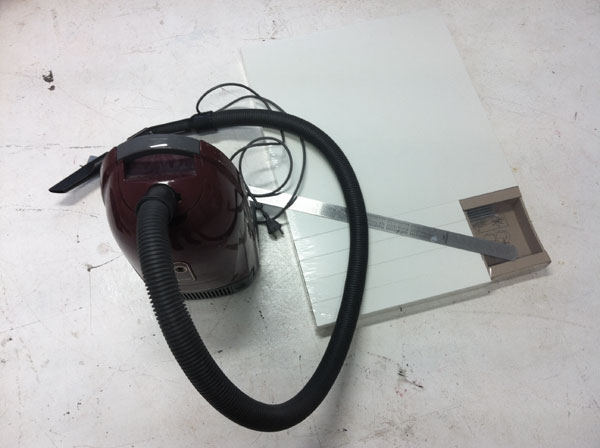 |
Old vacuum cleaner and the Ikea side table Lack. I chose "lack" because it is hollow - and cheap.
|
 |
I then draw myself a grid and drilled many holes.
|
 |
| Then I turned the table around and drilled a hole for attaching the vacuum cleaner. I then discovered that Ikea had added som kind of cardboard cells to strengthen it - most had to be removed or I wouldn't get the right suction. |
 |
To attach the vacuum cleaner in a smarter way I went and bought plastic curved pipe (for plumbing). (Middle-aged men looked at me in a weird way when I walked around with the slang of the vacuum cleaner around my neck as a snake and tried to attach it to different plumbing pipes.).
As the pipe wasn't a perfect fit for the drilled hole - which I didn't want it to be - I made it bigger with several layers of black electrical tape. It then got more flexible in the connection, which means removable, but was still tight enough. (I had first thought I would put silicone, but realized I wanted to be able to turn the pipe to be able to attach the vacuum cleaner in different angles to make the table more flexible)
|
 |
I had bought special hinges for screen printing, as a short-cut, which I then mounted on the side. As I had discovered the the table was weaker in constructions than I had thought I glued a piece of wood on the border and attached the hinges there.
(You could construct you own hinges with screws for attaching the screen printing frames, I'm sure)

As I wanted my table to be placed on other tables I bought short legs. When I found these legs I got extra happy - this ways I could secure my table to the bigger table! I plan to drill holes in my other working bench and attach the table legs' screws from in-under.
|
 |
Voilà - it is ready!
I've test printed and everything works smoothly.
|
Subscribe to:
Posts (Atom)


 Posts
Posts


